31 January 2011

The lonely sport

It seems like every other year, a significant movie about boxing, baseball, basketball or even golf comes along.  In 2010, there was The Fighter which had generated a lot of interest from critics.  The year before that it was Mickey Rourke’s performance in Aronofsky’s The Wrestler.   But there’s nothing much about tennis, the sport I love to watch, the one I know everything about but don’t play.   I’m still waiting for Hollywood to produce the definitive tennis film.

It didn’t help that Rafa or Roger didn’t make the finals in Melbourne last weekend.  I suspect Novak and Andy’s game the other day was a low-rater for a Grand Slam finals.  If R & R continue to not be in top form, Hollywood would only be disinterested further. 

In the last decade, I can remember only three films that touched on tennis:  The Royal Tenenbaums, The Squid and the Whale and Matchpoint.  Woody Allen’s Matchpoint devotes the most screen time to the sport.   Its lead character is a tennis coach.    The net ball is used as a recurring metaphor – the ball, or one’s fortune, could go either way.   But it isn’t really about the life of a tennis player.  More like the social-climbing and murderous Tom Ripley in an all-white sports outfit.

So why the lack of tennis films in spite of the sport’s high stakes and the huge fan base of its top players?  Is it too graceful a sport and devoid of the violence that Scorsese (Raging Bull) could exploit for cinematic effect?  Too elitist, and has none of the ingredients of the familiar “working class hero who triumphs over life’s obstacles” genre?  It hasn’t got much sleaze?

I think it’s the loneliness of the sport.   There’s no other popular sport where the athlete is barred from getting too close to another person.  The tennister comes out of the locker room with no caddy to lug his huge bag.  He can’t speak with his opponent or his coach.   In between games, he sits under the umbrella by his lonesome.   Yeah, I don’t see a blockbuster happening with solitude. 


29 January 2011

A hipster wedding


\hip-stur\n. One who possesses tastes, social attitudes, and opinions deemed cool by the cool. (Note: it is no longer recommended that one use the term "cool"; a Hipster would instead say "deck.") The Hipster walks among the masses in daily life but is not a part of them and shuns or reduces to kitsch anything held dear by the mainstream. A Hipster ideally possesses no more than 2% body fat.

-The Hipster Handbook, Robert Lanham

Hipsters also reject mainstream fashion, opting for vintage and thrift-store apparel, hats, sneakers and thick-rimmed glasses.  Their taste in music is just as un-mainstream – very ‘emo’, obscure, underground.

I just came from a hipster wedding. I’m so glad I’ve got hipster co-workers.  I get invited to their weddings which are more fun than usual.  My friends’ invite says “till death do us party”.  Couldn’t have been more apt.

Their invite also came with a 45 vinyl, and sartorial instructions: look dandy (bowties, neckties, vests, sneakers, hats, suspenders).  The couple exhorted their friends not to gift them with rice cookers.  Wedding ninang Raquel thought times had really changed. Parents are more accepting of their kids’ eccentricities.  When Raquel sent out her own wedding invites, her mother-in-law was shocked that hers didn’t have a second envelop.

The dandy groom with a funky brooch
The bride in a Mich Dulce. Awesome.
Pre-nup pic
The VW bridal car
The U.P. Bonsai Garden
Part of the entourage
Vinyl installation
Most guests wore Chucks.
Cotton candy giveaways
Yup, that's a skull on the wedding cake.

Thanks to the newlyweds for making me a part of their fab wedding.  Congratulations, and I pay further tribute to you by sharing a clip of the ultimate hipster movie.  Nothing’s more ‘cool’ than Godard’s 1960 classic Breathless.  You’re our modern-day Jean-Paul Belmondo and Jean Seberg.

26 January 2011

Renovation fatigue

The work on my new place hasn’t even started, but I’m already having renovation fatigue.   I’ve scoured bookstores, friends’ bookcases and magazine stands looking at design references.   I’m running out of Post-its to bookmark the ones I want to copy.  I thought, for a change, I should go to the movies for further inspiration.

Art direction in movies is as vital as having a great script.  It sets the mood and tone of the movie, and defines the key characters.  If not done right, the movie would flunk the requisite ‘willing suspension of disbelief’.  I especially like how the ‘look’ or details are amplified for a delicious visual experience. 

I like the clean, strong, masculine lines in –

Gattaca


Inception
The Holiday

Plant life will be sculptural –

The Lake House

Old, ornate mirrors must figure –

The Imaginarium of Doctor Parnassus

Must have a statement sofa –

Mr. & Mrs. Smith
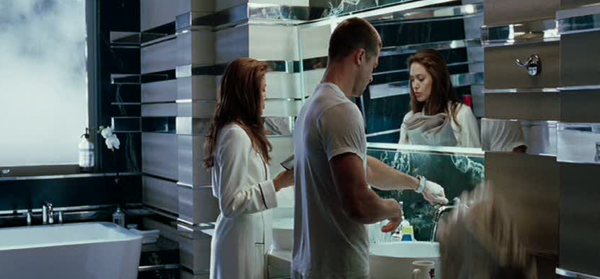
A very modern bathroom –

Mr. & Mrs. Smith

I’m not doing 60s but there could be some splashes of color from the 60s –

A Clockwork Orange

In the Mood for Love
The charm of 50s furniture –

Revolutionary Road

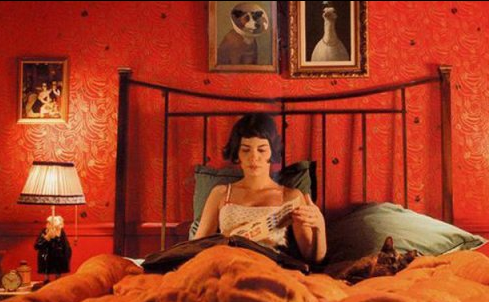
Yup, red is a favorite accent.

Twilight

Volver
Ocean's Thirteen
Amelie

There’s a lot to borrow from a recent movie that’s bad but beautifully art-directed.  All from Sex and the City 2 -


Must also copy the iconic blue door in Notting Hill.


I love how movies make you dream.


24 January 2011

Drudgery


Contrary to what Sharon Cuneta showed you in Madrasta, or Maricel Soriano in Separada, advertising work is not at all glamorous.  We dress very casually.  I spend much of the time writing on the computer, and the output is far from prose.  It’s mostly science, distilling consumer information and marketing data into strategic abstracts.  And there are the countless meetings, where exchanges are formal and business-like, not really high-drama.  If you think about it, there’s no film that has captured life in an ad agency accurately.  Maybe the TV series Mad Men, but that was set in the 50s/60s, plus there are more women in top-level positions now, and smoking is not allowed inside the office.

But agency work is fun.  The wild, passionate people I work with keep me going.  Think Crazy People (starring the late Dudley Moore) but with milder episodes of insanity. 

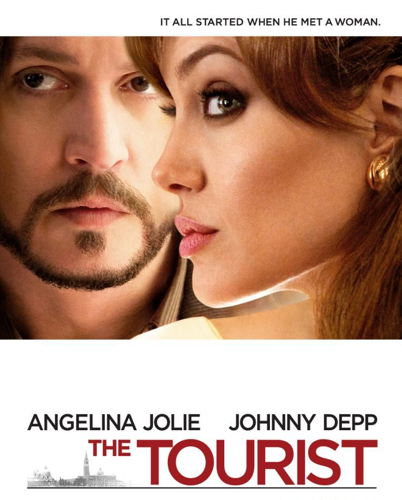
Two creative processes we have most fun with: developing name studies for a product/line extension/event/promotions, and casting talents for a commercial.  Which brings me to the movie of the day, after this long preamble -- The Tourist.  It’s the first movie I’ve seen in my week-long leave from work.  The Tourist  must the blandest movie title for 2010.  And the worst onscreen chemistry since Portman and Christensen. 

There must be a better way to spend my break from work that I love.


21 January 2011

It's generational!

Co-worker Rocky’s topic for our monthly share-in was “how to understand and deal with millennials in the workplace”.  Millennials are those born in the period 1977 to 1998.  They’re collectively marked by dependence on technology and social networking, a neo-liberal approach to politics and institutions (especially religion), and ecological awareness.  At work, they perform well in groups, are in constant need of mentoring. It’s also easy for them to quit and look for better opportunities, being risk-takers.

Generation X (1965-1976) are a much more independent lot.  They’re usually referred to as the latch-key kids whose parents, the Baby Boomers (1946-1964), were busy improving and redefining social, political and economic conditions, and rebuilding everything that the second world war destroyed. The Gen X profile is grunge-loving, indifferent, alienated, distrustful of authority and rigidity; while Boomers, are idealistic, have strong personal values and an overachieving, competitive work-ethic, always yearning for recognition in terms of visible rewards.

A discussion on these three diverse generations would require a long sociological dissertation.  Based on such profiling, I could at best try to name the movies that best mirror each generation.

Baby Boomers:  The Graduate (1967)
Angst-y Benjamin Braddock (Dustin Hoffman) rejects his parents’ (born pre-war) artificial values, and wants to take a path that’s different from what his parents planned for him.  He seeks emotional attachment with cinema’s first significant cougar, Mrs. Robinson (Anne Bancroft).  He turns his back on his Republican beginnings, and rides (a bus) off into the sunset with his true love, intent on leading a life that’s more meaningful.


Generation X:  Reality Bites (1994)
Lelaina: I just don't understand why things just can't go back to normal at the end of the half hour like on the Brady Bunch or something.
Troy Dyer: Well, 'cause Mr. Brady died of AIDS. Things don't turn out like that.


Millennials:  Juno (2007)
Her androgynous name alone tells you that her generation is not bound by traditional gender expectations -- they celebrate diversity,  Juno the millennial is smart, confident and knows what she wants.  If she were a boomer, she would’ve been tormented about teenage pregnancy.  She’s actually blasé about the results of the frog test, keeps her baby, woos her boyfriend back, goes back to school because she’d like to have a career after giving birth.  Her world is teeming with opportunities, in spite of temporary complications.


Did I get it right?   Boomers, X-ers and Millennials, speak up!  


19 January 2011

"Tatlo, Dalawa, Isa" and the short form

In Laurent Tirard’s book Moviemakers’ Master Class (Private Lessons from the World’s Foremost Directors), German director Wim Wenders of Wings of Desire (which critics hailed as the best film of the 80s, later remade by Hollywood into City of Angels – dreadful!) laments how students and young filmmakers “no longer start out by making short films but shoot commercials or music videos instead”.  Their priorities have changed since Wenders’ generation where telling a good story is more important than visual gimmickry.

A sweeping statement , I think.  There are directors today, younger than Wenders, whose filmographies are quite impressive, and they started out in advertising.  From the Philippines, there's Cannes winner Dante Mendoza,  Mark Meily and Chris Martinez.  David Fincher (The Social Network), Spike Jonze (Being John Malkovich) and Michel Gondry (Eternal Sunshine of the Spotless Mind) also did a lot of commercials and music videos before making it big on film.

But it seems true that the primary impulse amongst Gen X’ers and Millennials is to make beautiful images, at the expense of creating narrative.  Could this be the influence of the graphic novel, considered more engaging than John Steinbeck or F. Scott Fitzgerald?  Or, could it be a nagging feeling that every story told had been told; so why bother creating new ones?

I really don’t know.  I may also be generalizing.  But it certainly wouldn’t hurt to hone one’s craft by making short films or shorter features.  We don't have as much access to such films these days.  The last significant collection of shorts would be Paris, je t'aime (2006).  Every serious DVD collector must have Paris, je t'aime, by the way.


Doing ‘featurettes’ or trilogies was quite popular in the 70s and 80s in local cinema.  A classic was Lino Brocka’s Tatlo, Dalawa, Isa (1974), a trilogy of shorts.  The short form gave Brocka the sense of urgency.  With not much time to spare, he had to tell a story quickly and tightly. The result was powerful, despite (or on account of?) the simple camerawork.  When Lolita Rodriguez screams “Sakim!” and "Mamatay ka! Mamatay ka!" in the episode entitled Bukas, Madilim, Bukas, you’d know what I mean.